How to Choose a White Label Web Development Partner (2026)

Get Your Free Website Audit
($3,000 Value)
- Uncover performance issues
- Identify SEO opportunities
- Security gaps, and quick wins
Table of Contents
- What is White Label Website Design?
- What is White Label Web Development?
- Why Not Just Hire Your Own Developer?
- Freelancer, Offshore Contractor or White Label Agency
- Should your white label partner be in Australia?
- How to Find and Vet a White Label Partner
- Who owns the code, and what the NDA needs to cover
- Who talks to your client, and how fast anything moves
- Questions to Ask Before You Sign
- Why Agencies White Label With WP Creative
- Final Thoughts
- Frequently Asked Questions about White Label Web Development Partner
White label web development is when one agency builds websites for another agency under that agency’s brand. The client never knows a second team was involved. The agency that won the work keeps the relationship, the invoice and the credit. The partner delivers the build and stays invisible.
For creative studios, marketing consultants and branding agencies, it solves an obvious problem. You win the client. You own the strategy. You do not want to hire and retain a development team to service it.
This guide covers how white label arrangements actually work, what they cost, who owns the code, and the checks worth running before you put your name on someone else’s build.
What is White Label Website Design?
White label website design is when a specialist design team creates the website experience on behalf of another agency, with the work delivered under that agency’s brand.
The focus is on how the website looks, feels and guides users through each page. This can include page layouts, UI design, brand application, typography, colour systems, responsive design and interactive prototypes.
The design partner works behind the scenes, while the agency remains the main point of contact. You manage the client relationship, feedback and approvals, while the design team takes care of the specialist design work. This is especially useful if you run a marketing, SEO or other non-design-focused business. Website design may not be your core service, but it is often an important part of what your clients need. Instead of turning that work away or trying to manage it yourself, a white label design partner lets you offer it confidently under your own brand.
If you want to understand what should go into a complete website design project, our website design checklist covers the key stages and considerations from planning and user journeys through to mockups, branding and launch.
What is White Label Web Development?
White label web development is an arrangement where one agency builds websites for another agency under that agency’s brand. The delivering partner remains anonymous. The client-facing agency keeps the relationship, sets the price and takes the credit. It lets creative and marketing agencies offer development without hiring a technical team.
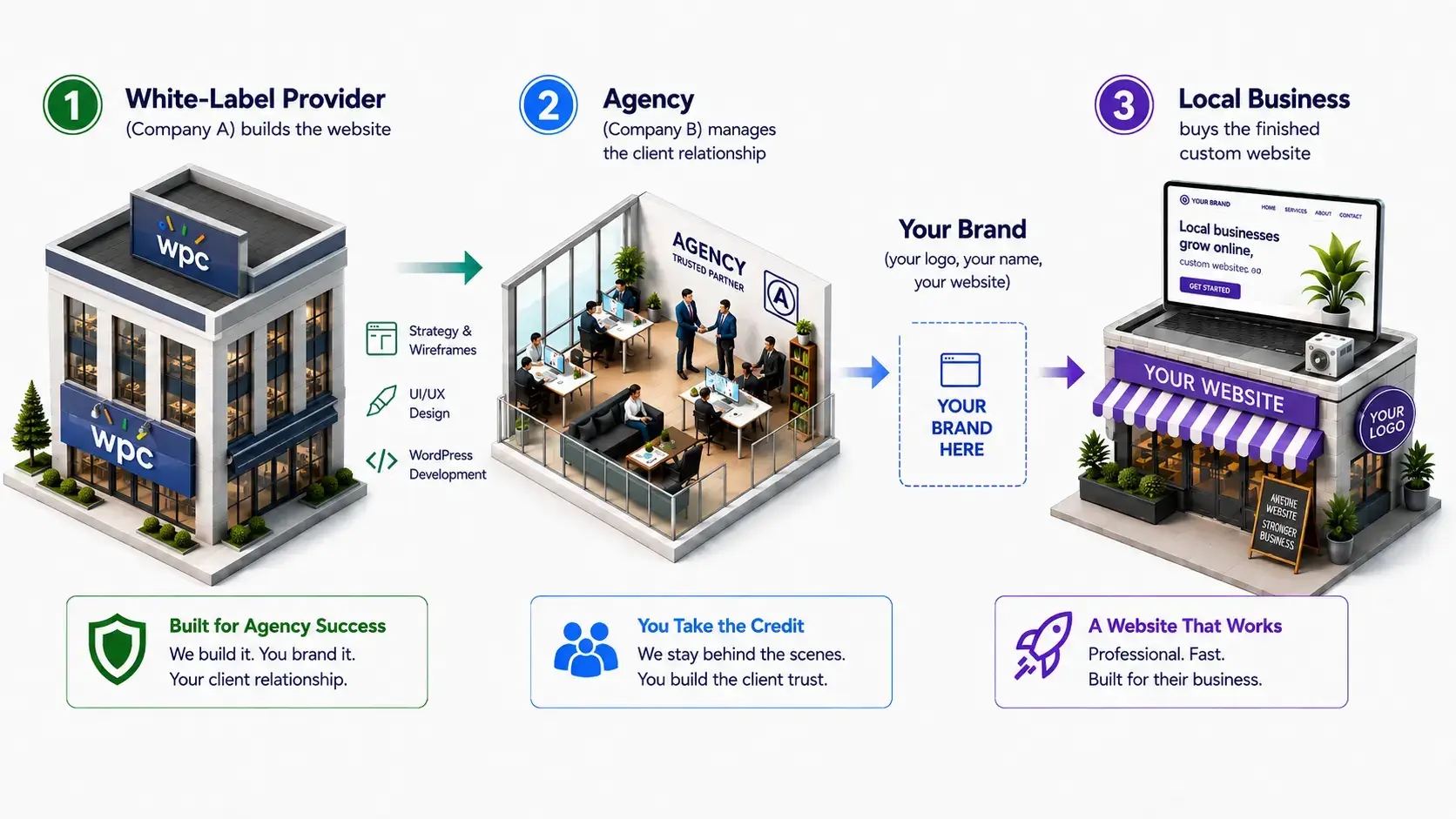
The flow is simple. A business needs a website and approaches Company B, an agency it already trusts. Company B wins the work but has no developers, so it briefs Company A, a specialist build partner.
Company A builds the site and delivers it to Company B. Company B reviews it, brands it as its own and hands it over. The client deals with one agency throughout and never knows Company A exists.
Everyone gets what they need. Company B sells a service it cannot staff and keeps its margin. Company A gets steady work without having to win it. The client gets a site built by specialists, from the agency it already chose.
Why Not Just Hire Your Own Developer?
Plenty of agencies try. Some make it work.
The problem is not finding a good developer. It is that you need a constant flow of development work to keep one busy, and agency pipelines are lumpy. You win three builds in a month and cannot staff them, then go quiet for six weeks and pay a salary against nothing.
Then there is the hiring itself. Getting it right first time is unusual, and a bad technical hire costs months. Getting it right and keeping them is a separate problem again.
A partner converts a fixed cost into a variable one. You pay for delivery when you have sold it. That is the whole argument, and for most agencies under a certain size it is decisive.
Buying development for your own business rather than reselling it? Our comparison of in-house developer vs agency covers the hiring trade-off, and our seven checks for choosing a WordPress development partner covers what to hold an agency to.
Freelancer, Offshore Contractor or White Label Agency
Three routes, three different risk profiles. The right one depends on how much of your client relationship is riding on the build.
| What you are checking | Freelancer | Offshore Contractor | White Label Agency |
| Team breadth | One skill set | Usually development only | Design, development, QA and PM on the same job |
| Quality assurance | Self-checked | Varies, often none | Separate QA function before handover |
| Project management | You do it | You do it | Dedicated PM |
| Who talks to your client | You, always | You, always | You, unless you invite them in |
| IP and contract | Often informal | Often unclear across jurisdictions | Written transfer on payment |
| Non-solicitation | Rarely covered | Rarely covered | Standard clause |
| When something breaks post-launch | Depends on availability | Timezone dependent | Defined response commitment |
| Continuity risk | High, they take other work | Medium to high | Low, team-based cover |
| Cost | Lowest | Low | Higher, with the overhead removed |
| Best suited to | Small single-skill jobs and quick fixes | High-volume, low-complexity builds | Complex builds where your client relationship is at stake |
The honest read: a freelancer is the right answer more often than agencies admit. If you need a landing page built, a plugin swapped or a layout fixed, paying agency rates for it is waste.
The calculation changes when the build is complex, the deadline is contractual, or your client relationship depends on it landing well. At that point you are not buying development hours. You are buying cover: someone else’s QA, someone else’s project manager, and someone who picks up the phone when your client rings at five on a Friday. Price the risk, not just the build.

Slow website wasting your marketing spend?
- Uncover performance issues
- Identify SEO opportunities
- Security gaps, and quick wins
Should your white label partner be in Australia?
Location matters less than most agencies think, and more than the cheap options admit.
It does not determine code quality. Good developers are everywhere, and some of the best WordPress work in the world ships from teams you will never meet in person.
What location determines is accountability. Who carries the risk, which law the contract sits under, and whether there is a person in your timezone who can make a decision when your client is unhappy.
What an Australian partner actually changes
If a project goes badly and you need to enforce something, doing it against an Australian entity is a different proposition to doing it across jurisdictions. That almost never comes up until it matters, and then it matters a great deal.
Invoicing is simpler too: AUD, GST, no currency exposure on a fixed price you have already quoted your client. And for enterprise clients and difficult conversations, being able to put a person in front of your client is worth real money on the few occasions you need it.
One more to check early rather than late. If your client is a government body, a healthcare provider or in financial services, there may be requirements about where their data sits and who can access it.
Offshore development is meaningfully cheaper, and for plenty of work it is the correct commercial answer. The risk is not skill. It is the gap that opens when something breaks and nobody in your timezone can resolve it.
Which is why most Australian agencies end up with a hybrid: an Australian entity holding the contract and the accountability, with delivery capacity offshore. That is the model WP Creative runs. Our team sits across Sydney and Kathmandu and we say so openly, because the question that matters is not where the developers sleep. It is who you call when your client is unhappy, and how quickly they answer.
Ask any partner claiming to be “Australian” where the development actually happens. An honest answer tells you something useful. A defensive one tells you more.
Where we work
WP Creative works with agency partners across Sydney, Melbourne, Brisbane and Perth, and remotely with agencies anywhere in Australia. Most partnerships run entirely over video meets and a shared project board, so proximity matters less than the working model.
How to Find and Vet a White Label Partner
Finding candidates is easy. Working out which one will still be answering the phone in month eight is the job.
Four stages, in order. Do not skip to the third.
Where to look
Ask other agency owners first. The best white label partners are rarely the ones marketing hardest. Agencies who have found a good one tend to keep quiet about it, but they will tell you if you ask directly. One honest referral beats a week of searching.
Then search properly. Google, plus the B2B rating platforms where agencies leave reviews with their names attached. Reviews on a partner’s own website are marketing. Reviews on a third-party platform are evidence.
Judge the portfolio on complexity, not polish. Anyone can show you a beautiful brochure site. Ask for their hardest project, the one with the awkward integration or the impossible deadline, and ask what went wrong on it. How a partner talks about a difficult build tells you more than ten case studies.
Check they build for agencies, not just for clients. These are different businesses. A partner used to direct clients will not have the anonymity, documentation and handover discipline that white label work needs.
What to ask before you shortlist
Technical breadth. Can they build a theme from scratch, or only assemble page builders? Do they handle WooCommerce, custom plugins, third-party integrations and headless builds? Do they offer ongoing maintenance, or do they hand over and disappear? You are buying the range you might need in two years, not just the job in front of you.
References you can actually ring. Ask for two agency clients you can speak to directly. Not testimonials, not logos. A partner confident in their delivery will make the introduction without hesitation.
Everything else worth asking is in the checklist further down, and it is worth working through before a test project rather than after.
Run a paid test project
Shortlist down to two, then give each a real job.
Pay for it. Free test work attracts partners with nothing better to do and produces output nobody was invested in. A partner who agrees to build for free is telling you what their time is worth.
Keep it small and real. A landing page, a template, a bug with a genuine deadline behind it. Big enough to expose their process, small enough that failure costs you nothing.
Watch the process, not just the output. The build quality is the least informative part. What you are actually testing:
- How they scope it. Do they ask clarifying questions, or just start?
- What happens when you change something midway.
- Whether you had to chase them for an update.
- How the handover arrives. Documented and tidy, or a zip file and good luck.
The output tells you whether they can build. The process tells you whether you can sell their work with confidence.
Then scale deliberately
Do not move your whole pipeline across after one good project. Debrief instead: tell them what worked, what did not, and what you need differently. How a partner takes that is the real test, because one who gets defensive over a landing page will be impossible on a six-figure build.
Give them a second project, then decide whether you have a supplier you use occasionally or a partner you build capacity around. Both are useful. Knowing which one you have is what stops you promising a client something your partner cannot deliver.
Four red flags at the vetting stage
- They will not name a project manager.
- Their portfolio is all design, no technical complexity.
- They quote before they have asked a single question about your client.
- They agree to do the test project for free.
Who owns the code, and what the NDA needs to cover
This is the part most agencies skip, and it is the part that costs them when a relationship goes wrong.
You are putting your name on someone else’s build and selling it to a client who trusts you. If the ownership is unclear, or the partner is free to approach your client, you have handed over the one asset your agency actually owns: the relationship.
Sort it before the first project, not after the third.
Intellectual property should transfer to you
In a properly structured white label agreement, all intellectual property in the delivered work transfers to the client-facing agency on final payment. That covers the code, the design files, the custom functionality and anything built specifically for the project.
The partner keeps no claim over it. You are then free to transfer ownership to your client under your own terms.
Two things to watch. First, some partners carve out their own reusable frameworks, plugins or block libraries from the transfer. That is reasonable and common, but it needs to be named in the contract, and you need to know what happens to those components if the relationship ends. Second, check that the transfer is unconditional on payment, not subject to an ongoing licence.
The NDA needs to cover more than the code
A standard NDA protects confidential information. A white label NDA needs to go further, because the thing you are protecting is not technical. It is commercial.
At minimum it should cover:
- Client identity: The partner cannot disclose who your clients are, to anyone, including in their own portfolio or case studies.
- The arrangement itself: The partner cannot disclose that they built the site, or that you use a white label partner at all.
- Commercial terms: Your rates, margins and project values stay private.
- Duration: Confidentiality should survive the end of the engagement, not expire with it.
Non-solicitation is the clause that matters most
Ask directly: can the partner approach your client after the project ends?
The answer needs to be no, in writing, for a defined period. Without it, you have spent your budget introducing a development agency to a client who now knows a cheaper route to the same work.
Most reputable partners will agree to this without hesitation, because their business model depends on agency relationships rather than direct client acquisition. Hesitation here tells you which model you are dealing with.
Who talks to your client, and how fast anything moves
Ownership is the contract question. Communication is the daily one, and it is what actually breaks white label relationships.
Your client does not know the partner exists. So every delay, every silence and every missed deadline lands on you. You absorb the risk of a team you do not manage. Pin the working model down before the first project, not during the first crisis.
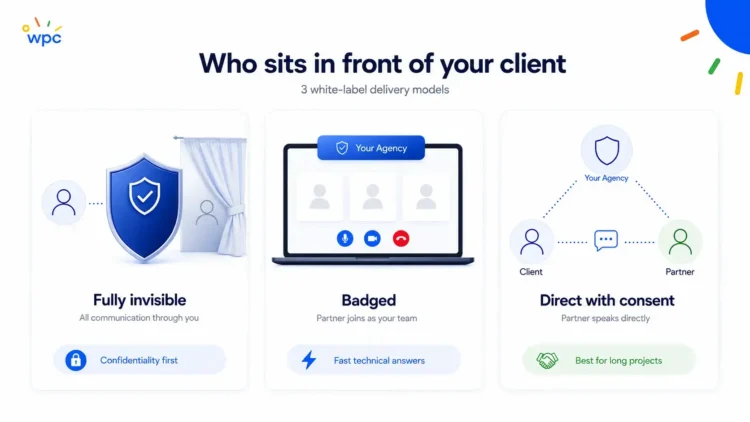
Who sits in front of your client
There are three models, and you need to know which one you are buying.
Fully invisible. The partner never speaks to your client. Everything routes through you. Cleanest for confidentiality, slowest for anything technical, and it makes you the translator on every question you cannot answer.
Badged. The partner joins client calls presented as your team, using your branding and email. Faster on complex builds because the technical answer comes first-hand. Requires trust and a tight NDA.
Direct with consent. The partner is disclosed and deals with your client directly on delivery while you hold the commercial relationship. Rare in true white label, but it suits long-running projects.
None of these is wrong. The mistake is not choosing, then discovering mid-project that your partner assumed one model and you assumed another.
Turnaround, and what “fast” actually means
“Quick turnaround” means nothing. Get specifics against the four things that come up:
- New request acknowledged. How long before someone confirms they have it? Hours, not days.
- Scoped and quoted. How long before you can give your client a price and a date?
- Standard change delivered. A new landing page, a template tweak, a content update.
- Complex build delivered. Integrations, custom functionality, anything touching a third party.
Ask for these as commitments, not averages. An average hides the bad weeks, and the bad weeks are the ones that cost you a client.
Then ask the question that actually separates partners from suppliers: my client’s site goes down at 4pm on a Friday, what happens?
What good looks like
| What you are pinning down | Weak answer | What to hold out for |
| Day to day contact | Shared inbox | Named project manager |
| Acknowledgement | “We’re usually quick” | Committed response window |
| Progress visibility | Ad hoc email updates | Shared board you can see without asking |
| Client-facing role | Undefined | Agreed model, written down |
| Emergencies | Same queue as everything else | Separate escalation path and contact |
| Cover during leave | “He handles that” | Documented handover, second team member briefed |
| Timezone overlap | Not discussed | Stated hours of overlap with your working day |
On timezone, honestly
Plenty of white label partners run a hybrid model: account management in your market, technical delivery offshore. It is the reason the economics work, and it is worth being clear-eyed about the trade.
Handled well, it is an advantage. Work progresses overnight and lands ready for your morning. Handled badly, every clarification costs a full day, and a two-hour job takes three.
The question is not whether the team is offshore. It is how many hours of overlap you get with your own working day, and whether there is someone in your timezone who can make a decision without waiting.
Questions to Ask Before You Sign
Nine questions. If a partner cannot answer all nine in a single email, they have not thought about the arrangement, which means you will be the one thinking about it when something goes wrong.
Ownership and contract
- Does IP transfer to us, and at what point?
- What is carved out of that transfer, and what happens to those components if we stop working together?
- Is there a non-solicitation clause, and for how long?
- Does the NDA cover our client’s identity and the fact that we use a partner at all, not just technical information?
Delivery
- Who is our named contact, and who covers when they are away?
- How many hours a day does your team overlap with our working day?
- Can we see progress without having to ask for an update?
Commercial
- Which entity are we contracting with, and is it Australian registered?
- Can you give us a rate card rather than quoting job by job?
Vague answers are answers. A partner who deals with agencies at volume has been asked all of this before and will have it ready.
Why Agencies White Label With WP Creative
Run us through the same checklist we shared earlier.
10+ years building WordPress websites for Australian brands, so you get the expertise rather than a team learning your platform on your project.
Every build gets a named project manager, not a shared inbox. IP transfers to you on final payment. We do not approach your clients, and that is in the contract, not just the conversation.
Our development team works 10am to 7pm Sydney time, so you are not waiting overnight for an answer. Additionally, we provide ackowledgement within 1 hour for P1(urgent) issues and resolution within 4 hours.
Our team are Marketechs™: marketing heads and technical hands on the same people. For you that is protection, not competition. We will tell you when a build decision is going to cost your client conversions or rankings, before it ships and before it lands back on your desk.
1,200+ Australian businesses served since 2016. 100+ five-star Google reviews. Rated the #1 WordPress agency in Australia on Clutch.

“We’ve worked with a lot of agencies over the years, and I can confidently say that WP Creative are hands down the best development agency we’ve worked for.”
– Scott Roberts, Creative Director, Studio Helm
Final Thoughts
Choosing a white label web development partner comes down to more than price and portfolio. You are handing over the delivery of work your client believes you are doing, which means the partner you choose becomes quietly responsible for your reputation as well as your margin.
The agencies who get this right tend to do the unglamorous things first. They agree who owns the code before a line of it is written. They pin down how communication will work before there is a problem to communicate about. And they run a small paid project before committing a client deadline to a team they have never worked with.
None of that takes long. It simply needs doing before the first real project rather than after the first difficult one. Get it right and a good partner becomes capacity you can sell without carrying the cost of a team. Get it wrong and you tend to find out at the worst possible moment.
If you are working through that decision now, our White Label WordPress Development Services page sets out how we work with agencies: how projects are scoped, who you deal with day to day, and what it costs.
Frequently Asked Questions about White Label Web Development Partner
What is the difference between white label web design and white label web development?
White label web design covers the visual work: UI, layout, brand application and prototypes. White label web development covers the build: templates, functionality, integrations, testing and deployment. Some partners offer one, some offer both. If you only outsource design, you still need someone to build it, so check which end of the job is actually covered before you sign.
How much does white label web development cost?
Most white label work is priced per project or on a monthly retainer. Project pricing suits one-off builds. Retainers suit agencies with steady volume and usually carry better rates. Australian development teams typically sit at the premium end of the global market, well above offshore rates. That gap is the trade you are making: higher input cost against local timezone, local accountability and a team you can put in front of a client if you need to.
What you resell it for is your call, and it should be set by the value to your client, not by a markup on the invoice. Ask any partner for a rate card rather than quoting job by job. Fixed inputs let you price client work with confidence and protect your margin when scope moves.
Who owns the code and intellectual property in a white label arrangement?
You should. In a properly structured white label agreement, IP transfers to the client-facing agency on final payment, and the delivering partner retains no claim over the work. Get this in writing before the first project. If a partner will not put IP transfer in the contract, that is a reason to walk.
Will a white label partner ever contact my client directly?
Not under a genuine white label agreement. The partner works behind your brand and has no direct contact with your client unless you invite them in. Some agencies do bring the partner onto calls as their own team member, which works well on complex builds. Either way, the rule should be written into the NDA, not assumed.
Is a freelancer or a white label agency better for an agency?
A freelancer is cheaper and fine for small, single-skill jobs. A white label agency gives you designers, developers, QA and project management on the same job, which is what complex builds need. The deciding factor is usually continuity. Freelancers take other work, get sick and move on. If your client relationship depends on delivery, the agency model carries less risk.
Which agencies in Australia offer white label web development?
Several Australian agencies offer white label development, and many run a hybrid model with local account management and technical delivery offshore. When comparing them, check where the team actually sits, who your day to day contact is, and what the turnaround commitment is in writing. WP Creative works with agencies across Australia through our white label WordPress programme, with delivery split between Sydney and Kathmandu and a named project manager on every build.

Get Your Free Website Audit
($3,000 Value)
- Uncover performance issues
- Identify SEO opportunities
- Security gaps, and quick wins