Headless eCommerce Development Services
Your theme decides how your store looks and how fast it loads. Headless ecommerce development removes that limit, while your products, orders and checkout stay on the platform you already use.
- API-first commerce architecture
- Custom front end, no theme limits
- Rankings protected through migration
Book a Strategy Call


100+ 5 Star Reviews









Ecommerce Results We've Delivered
See what our recent eCommerce builds delivered across speed, search visibility and conversions, and the performance standards we bring to headless development.


Our Headless Ecommerce Development Services

Custom Storefront Development
The path from category page to checkout is where revenue is won or lost. We build that journey as a custom front end in React or Next.js, server-side rendered so pages load quickly and search engines read them properly.

ERP, Stock & Order Integration
Nothing costs more trust than selling stock you do not have. We connect the storefront to the back end systems that hold the truth: ERP, warehouse and shipping. Availability, pricing and order status stay accurate across every page.

Merchandising Enablement
Your team should still be able to run a sale. We set the storefront up so merchandisers change collections, promotions and campaign content without waiting on a release, while structural work stays with us.

Checkout & Payments Integration
You do not need to rebuild checkout. Payments, fraud handling and compliance stay with your commerce platform. We connect the storefront to it cleanly, so the buying experience never becomes the risky part of the project.

Catalogue Migration & SEO
Moving a large store means moving thousands of product URLs. We inventory every one, map redirects before development starts, and monitor indexation after go-live, so the rankings you have already paid for survive the move.

Multi-Channel Commerce Delivery
One catalogue, more than one sales channel. We deliver product data to marketplaces, mobile apps, social media platforms and in-store kiosks from the same commerce backend, so nothing drifts out of sync between systems.

Performance Engineering
Your worst day for traffic is usually your best day for revenue. We load test before launch and build caching and delivery that hold when a sale, a campaign and a media mention land in the same hour.

Commerce Architecture & API Layer
In a decoupled architecture the application programming interfaces are the single point of failure. We design how product, pricing and stock data is queried, cached and delivered, so the storefront stays fast as traffic and catalogue both grow.

Search & Product Discovery
On a large catalogue, most revenue starts with a search box or a filter. We build fast faceted search and product discovery against your catalogue, so shoppers narrow thousands of products to the right one without waiting for a page reload.
Is a Headless Ecommerce Platform Right for Your Store?
Is a Headless Ecommerce Platform Right for Your Store?
Headless is a bigger commitment than most agencies admit. It pays off for a particular kind of ecommerce business, and it is worth knowing early whether yours is one of them.
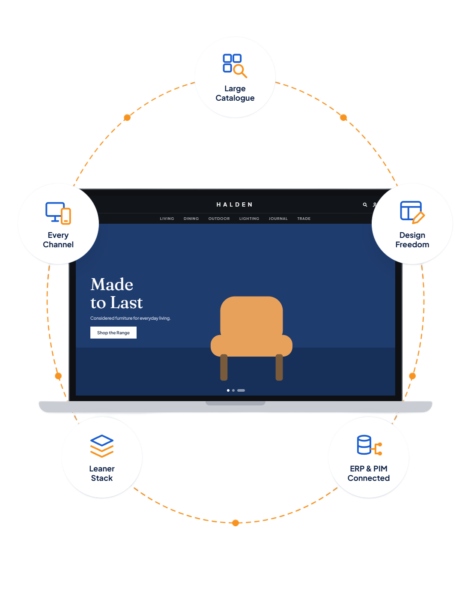
- Catalogues past a few thousand SKUs where filtering and search slow down long before the rest of the site does.
- Retailers selling across multiple channels who are tired of product data drifting out of sync between separate systems.
- Brands whose design keeps getting cut back to whatever the template can actually render.
- Ecommerce stores carrying twenty or thirty plugins where fixing one thing costs speed somewhere else.
- Businesses with an ERP or PIM at the centre and a storefront that was never built to talk to it.
Headless Ecommerce Plans & Packages for Australian Retailers
Care Plan
Your website stays stable, secure, fast, tracked and continuously improved.
- From 20 development hours per month
- Monthly core, theme & plugin updates
- Security checks, malware prevention & spam clean-up
- Scheduled backups (off-site)
- Uptime and server health monitoring
- Staging environment + manual QA testing
- Priority bug fixes & site improvements
- WPO Platform monitoring, included
- 1-hour emergency response SLA (P1, 8am–8pm)
- Phone & email support
- Emergency support when needed
- Monthly maintenance report
- Dedicated monthly development and improvements (beyond core maintenance)
Scale Plan
Your website becomes the growth engine your marketing team can finally rely on.
- Everything in the Care Plan,
plus the growth engine - From 40 development hours per month
- Dedicated delivery pod: PM, developer, QA, UX/UI
- Kickoff, monthly sprint planning, weekly delivery cadence
- Signed-off 90-day roadmap
- Speed and Core Web Vitals optimisation
- Advanced tracking: GA4, GTM, pixels, events, attribution hygiene
- Behaviour insights: heatmaps, session recordings, Microsoft Clarity
- Landing page optimisation & UX optimisation
- CRO: conversion leaks, trust, CTAs, funnel friction
- Technical SEO, AEO and AI search visibility
- Direct collaboration with your marketing agency
- Quarterly Business Review with a commercial strategist
- Monthly performance scorecard: 5 to 6 agreed metrics
Enterprise Plan
One accountable team running every website, with the reporting your executives need.
- Everything in the Scale Plan, plus enterprise-grade depth and access
- From 80 development hours per month
- One accountable team across every website
- Named Account Director (relationship & strategy ownership)
- Weekly delivery cadence and WIP meeting
- Board-ready monthly reporting: progress, risk, next steps
- 12-month roadmap governance, reviewed quarterly
- Release governance and change control
- Custom integrations and backend development
- ERP, CRM and third-party system support
- Vendor risk assessments completed on your behalf
- ISO 27001 and SOC 2 readiness support
- Direct access to developers, fewer layers

“We've worked with a lot of agencies over the years, and I can confidently say that WP Creative are hands down the best development agency we've worked for.”
Scott Roberts
Creative Director, Studio Helm
“They were really good in terms of their ability to deliver. Their working style, their collaboration style, and also they're very cost effective.”
Pete Williams
Founder, Deloitte Digital
“With their help, our two large, content-heavy news websites now rank as A's on GT metrics with greatly increased speeds.”
Mark Brown
Founder, Engage Media
“They helped us redesign our website and have introduced a number of features as part of that website, which have really made us reach the goals.”
Joydeep Hor
Founder & Managing Principal, People + Culture Strategies
Why Choose WP Creative as Your Headless Ecommerce Agency
Plenty of agencies can build a headless storefront. Fewer will tell you what it costs to run, or what happens to your rankings on the way there.

Built By Marketechs™
Our developers understand why a product page converts, not just how to build one. That judgement shapes the decisions that matter, from how filtering behaves to what loads first.

Commerce, Not Just Code
A storefront can look excellent and still sell badly. We understand catalogues, variants, filtering and how customers actually move from browsing to checkout, so the build is shaped around conversion.

Senior-Led Development
Every line is written or reviewed by a senior developer. That matters more on a headless build than on a theme, because there is no platform underneath to catch a poor architectural decision.

Rankings Protected Through Migration
Every URL mapped and every redirect signed off before development begins, not after launch. Our in-house SEO team works inside the build, so search visibility is engineered rather than assumed.

WPO Platform Monitoring
Our WPO Platform™ watches your store continuously and flags issues before you feel them, ranked by impact. You do not get another dashboard to manage. You get a team that already knows.

One In-House Team
Design, development and SEO sit within our own team rather than a rotating bench of contractors. Sydney head office, Australian business hours, and a maximum of ten clients per team.

No Platform Lock-In
Headless architecture separates your front end from your commerce platform, so you can replace one without rebuilding the other. We document the stack properly, so changing direction later takes days rather than becoming a negotiation.

Long-Term Support
A headless store is an application rather than a website. Frameworks move, dependencies age and third party tools change. Our plans cover the work that keeps it performing in year three, not only at launch.
Headless WooCommerce, Built for Speed
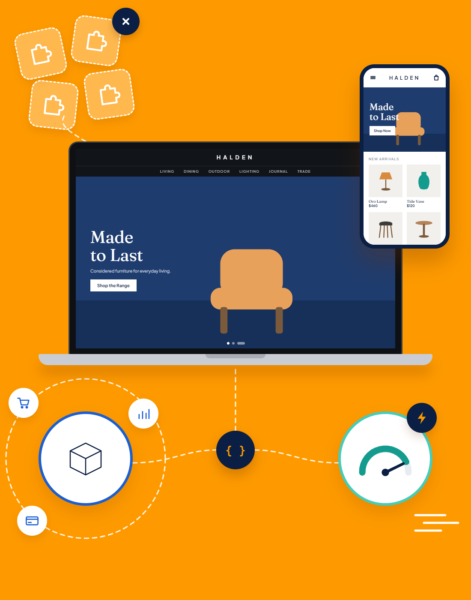
Most WooCommerce online stores get slow the same way. A plugin for reviews, one for filtering, one for wishlists, one for the mega menu.
Each was the right call on its own. Together they are three seconds of load time.
A headless setup takes the storefront out of that stack. WooCommerce keeps running products, orders and stock in the admin your team already knows.
The front end becomes a separate application, built in React or Next.js against the WooCommerce API. It stops inheriting every plugin decision made in the last five years.
Your workflows do not change. Orders process the same way, stock updates the same way, and your reporting keeps working exactly as it does now.
What you lose is the trade-off. Adding a feature stops costing you speed, and keeping the site fast stops costing you features.
Shopify Ecommerce Development Beyond Theme Limits
Shopify Ecommerce Development Beyond Theme Limits
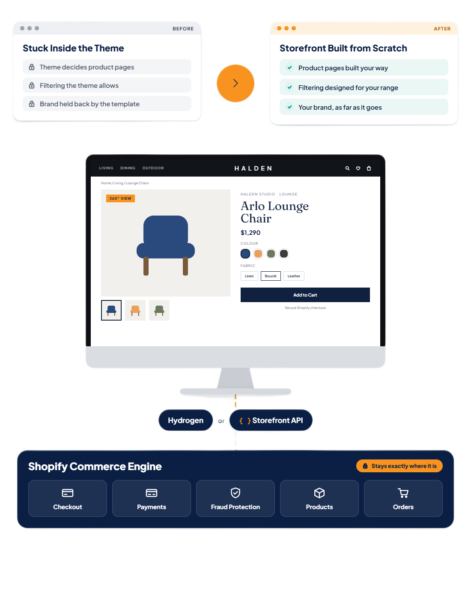
Shopify does the hard part well. Checkout, payments and fraud protection are not worth rebuilding, and a headless approach does not ask you to.
All of that stays exactly where it is.
What changes is the front of your store. Right now, your theme decides how product pages look, how filtering works, and how far your brand can go.
We take the storefront off the theme and build it from scratch, while the Shopify commerce engine keeps running products, orders and checkout underneath.
We build on Hydrogen, Shopify’s own framework for headless storefronts, or on the Storefront API when that suits the project better. We will tell you which one fits before you commit.
AI-Assisted Development, Senior-Led Decisions
AI has made the repetitive part of a build faster. It has not made the judgement part any easier.
In a headless store, the repetitive part is real. Product page templates, component patterns repeated across hundreds of category pages, data mapping for a catalogue migration. AI handles that work well.
What it does not handle is the decision. How your catalogue should be modelled, which integrations carry risk, what happens to your URLs during the move.
Those stay with senior developers, and every line AI writes is reviewed by one of them before it ships.
The tools changed. The standards did not.


Discovery
We start with your catalogue, integrations and traffic. Before anything is designed, we pressure-test whether headless commerce is the right call, and say so in week one if it is not.

Catalogue Modelling
We map products, variants, bundles and pricing rules first. Get this wrong and filtering slows at 5,000 SKUs. Get it right and the catalogue grows without the storefront degrading.

Storefront Design
Designed in Figma around how people buy from you. Category browsing, filtering, product page and path to cart, all decided deliberately and approved before development starts.

Storefront Build
Built in React or Next.js, server-side rendered from the first commit. Core Web Vitals targets are agreed up front and measured throughout, not checked at the end.

Systems Integration
We connect the storefront to your commerce platform, then to ERP, stock, shipping and marketing automation platforms. Each third party integration is tested for what happens when it fails, not just when it works.

Migration Mapping
Every URL inventoried and mapped before development finishes. Structured data rebuilt on the new front end. This is the step that decides whether you keep the rankings you paid for.

Load Testing
Cross-device, cross-browser, checkout end to end. We load test against your worst expected day, because a store that holds on a Tuesday and falls over on a sale has failed.

Launch & Monitoring
We deploy, then watch indexation daily for a fortnight and performance on real visitor data. If something moved, we know before you do.

Store and Catalogue Review
We look at your current store's speed, how filtering behaves at your real SKU count, and where the storefront is costing you conversions today.

Migration Risk Assessment
We benchmark your rankings and Core Web Vitals now, then tell you what is protected in a move and what is genuinely at risk.

Scope and Costs
A clear proposal covering platform, scope, timeline and price. No lock-in, and no obligation to proceed.

“Of all the agencies we've worked with, WP Creative is the best, hands down.”
Scott Roberts
Creative Director, Studio Helm
Headless Ecommerce Development FAQs
Headless ecommerce architecture separates the presentation layer from the commerce backend. Your storefront becomes its own application, built in a framework like React or Next.js, while products, cart, checkout and orders stay where they are.
Decoupling the frontend from the backend means the two halves talk over an API instead of being welded together. Your business logic for pricing, promotions and stock stays exactly where it already lives, and the frontend and backend can now change independently of each other.
In traditional ecommerce the storefront and the commerce engine are one system. Traditional ecommerce platforms give you a theme, and that theme controls what the store looks like, how filtering behaves and how fast pages load.
A headless commerce approach splits the two, so the front end can be rebuilt without the backend moving at all. The trade is real. Traditional platforms are simpler and cheaper to run. A monolithic platform only starts to hold you back once your catalogue, your brand or your integrations outgrow what the theme allows.
Nothing, until you outgrow it. An all-in-one platform is faster to launch and cheaper to maintain, which is the right answer for most stores. The limits of a monolithic architecture show up later, when every plugin takes another bite out of page speed and your design keeps getting cut back to what the template will render.
What headless commerce offers instead is complete control of the front end, and with it, the tailored customer experiences that a shared template cannot produce.
Composable commerce goes a step further than headless. Rather than one headless commerce system sitting behind the storefront, you assemble best-of-breed services for search, checkout, content and product data, then compose them into a single experience. It gives you more flexibility and considerably more to manage. Most Australian mid-market retailers do not need it. Headless solutions on a single commerce backend deliver most of the benefits with a fraction of the operational overhead.
Yes, and it is one of the better reasons to go headless. The same commerce backend can feed your website, marketplaces, mobile apps, social media platforms, in-store kiosks and customer portals. Smart devices and voice commerce sit in the same category. One catalogue, one source of truth, however many sales channels you run.
Your commerce operations do not fragment across separate systems, which is usually what happens when each channel gets bolted on with its own product feed.
WooCommerce and Shopify. Most headless commerce platform decisions come down to what your business already runs rather than what an agency prefers, and we are not going to move you onto a different headless e-commerce platform because it suits us. Other eCommerce platforms can work headless, and if yours is one of them, we will tell you. What matters is that the platform fits your business needs, your catalogue and the team who has to run it after launch.
If you are still comparing options, explore some of the best headless CMS platforms before deciding which setup is right for your business.
Usually not. A headless platform costs more to build and more to run, and the payoff comes from catalogue scale, integration depth or design ambition. If your store is small and performs well, a headless commerce solution is money that would do more for you elsewhere. That said, customer expectations on speed have moved, so if your current store is genuinely slow the conversation is worth having before you rule it out.
Our headless ecommerce services include everything between the architecture decision and the store running well a year after launch.
A new build starts with catalogue modelling and works forward. A migration starts with a URL inventory and works backwards from what you cannot afford to lose. The middle is the same either way.
As a headless ecommerce development agency, we take on headless ecommerce website development end-to-end rather than handing over a storefront and leaving you to find someone else for the integrations.
Not if the migration is planned properly, and it is the single biggest risk in the project. We inventory every URL and map its redirect before development finishes, rebuild structured data on the new storefront, and server-side render every template so crawlers see your content rather than an empty shell.
After go-live we monitor indexation daily for a fortnight. Done badly, a headless rebuild can cost you months of organic revenue. Done properly, rankings carry across.
Most run eight to sixteen weeks, depending on catalogue size and how many systems need integrating. The storefront build is rarely the bottleneck. Content readiness, approval cycles and third party integrations set the real timeline. Senior development teams shorten it, because the architectural decisions get made once rather than revisited halfway through.
It depends on catalogue size, integration count and how much of the design is bespoke. Headless ecommerce development in Australia sits above a traditional build, because you are paying for a custom front end rather than a theme. We scope it against your business needs and give you the number before you commit, not after a discovery process.
Yes, and migration is a large share of the headless work we do. Your commerce backend usually stays where it is, which removes most of the operational risk. The storefront is rebuilt, the connections to your backend systems are re-established and tested, and URLs, redirects and structured data are mapped across before anything moves.
Usually yes, for content that is not product data. Campaign pages, editorial and landing pages sit better in a headless CMS than in a commerce platform. Larger organisations sometimes run a digital experience platform instead. Either connects to the storefront alongside your commerce backend, so your merchandisers and your content team both feed the same front end without competing for it.
After launch, usually yes. The frontend and backend can be worked on independently, which means faster development cycles once the architecture is settled. During the build it is the opposite. Headless takes longer up front than a theme, and development teams need to be senior enough to make architectural calls that hold. If speed to launch is the priority and nothing about your current store is broken, headless is the wrong tool.
No, and usually you should not. Payments, fraud handling and PCI compliance are solved problems on both WooCommerce and Shopify, and rebuilding them adds risk for no commercial return. Commerce functionality stays exactly where it is. The storefront changes, the checkout does not.
A headless store is an application rather than a website, so it needs the same care as any other plus attention to the storefront itself. Frameworks move, dependencies age and third party tools change. Our plans cover updates, security, performance monitoring and ongoing improvement.
You also keep access to our headless ecommerce development experts rather than starting a new conversation every time something needs changing.

© 2026 WP Creative, Naphix Pty Ltd. ABN: 65 610 345 198