How we grew an eCommerce store’s quote requests 75% on 28% more traffic?

Get Your Free Website Audit
($3,000 Value)
- Uncover performance issues
- Identify SEO opportunities
- Security gaps, and quick wins
Table of Contents
Tile Factory Outlet sells tiles to homeowners, renovators, and builders across Australia. They were already spending on Google Ads and getting people to the site. The problem was not getting traffic. The problem was what happened after the click.
When we picked up the project in September 2024, the site was carrying eleven years of accumulated technical debt. Product pages took too long to load, the back end was held together by manual processes, and visibility in search was slipping. People were arriving and leaving.
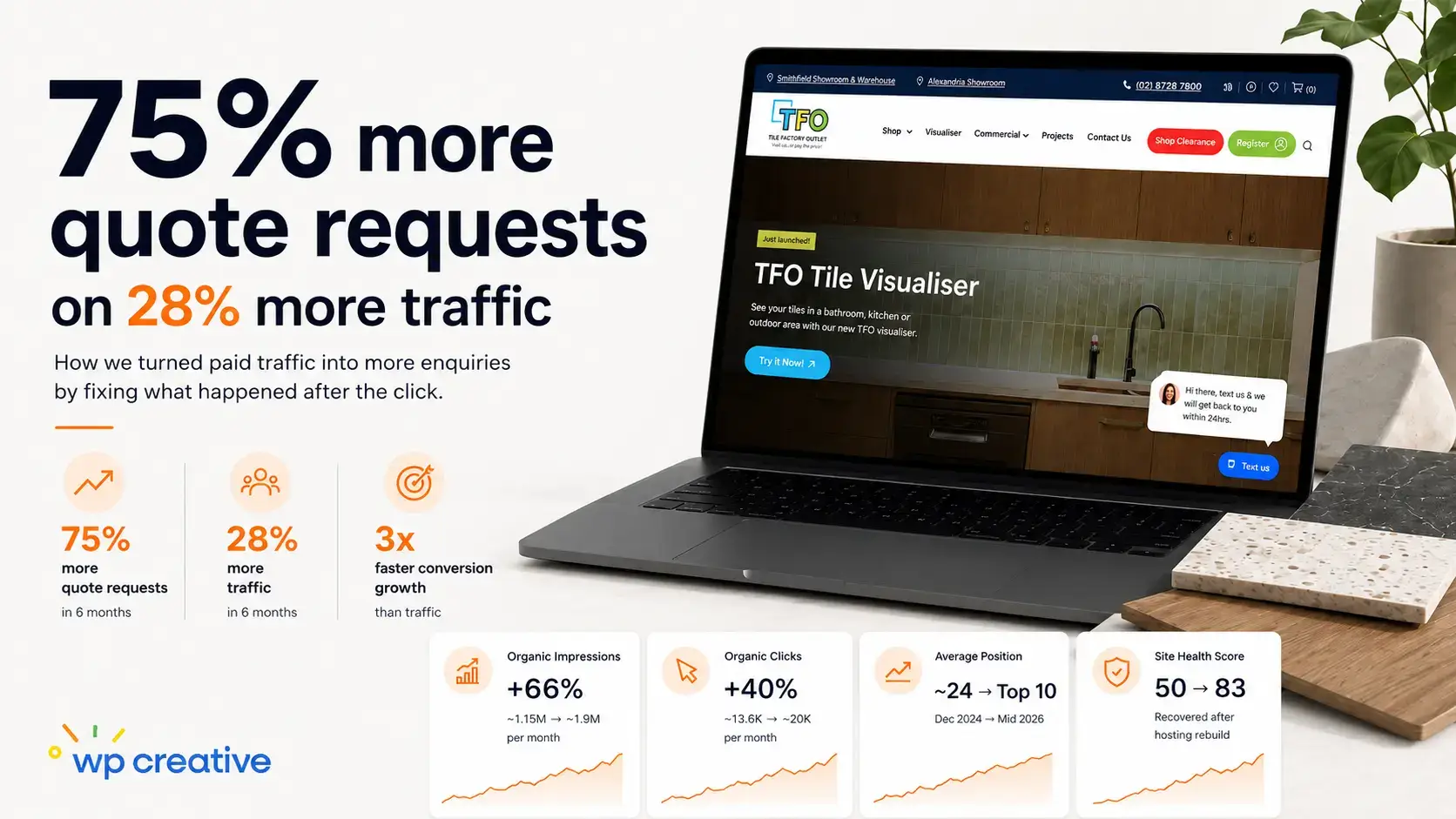
So we started at the bottom. We stabilised the site, rebuilt the back end, then rebuilt the organic foundation underneath it. Within six months, quote requests were up about 75% on roughly 28% more traffic, conversion rising close to three times faster than traffic itself.
Key takeaways
- Quote requests rose ~75% on ~28% more traffic in the first six months. Conversion improved nearly three times faster than visits.
- New users grew just ~20%, so the extra quotes came from converting demand TFO already had, not a bigger audience.
- Average position climbed from ~24 in December 2024 to single digits by mid-2026.
- Organic visibility grew alongside it: impressions up roughly two-thirds (~1.15M to ~1.9M a month) and organic clicks up about 40% (~13,600 to ~20,000 a month).
- The site went down early on, its health score fell below 50, then recovered to 83 after a hosting rebuild.
- The fixes that moved conversion were invisible: render-blocking pages, a broken variation selector, an unstable server.
The gap
TFO had the demand. Their ads were sending qualified buyers to the site every day. Tiles are a considered purchase, so most of those buyers do not check out in one session. They browse, they compare, they request a quote. That request is the conversion that matters.
The site was getting in the way of that request. A buyer who lands on a slow product page, hits a layout that does not load cleanly, or finds a variation selector that does not behave will leave. Every one of those exits was paid-for traffic walking out the door. The money spent on the click was wasted the moment the page failed to deliver.
So the plan was simple. Stop the leak. Fix what happens after the click, then build the organic foundation so TFO depends less on paid traffic over time.
What the audit found
1. The site was built on an 11-year-old foundation
The original TFO site was built around 2013 and later redeveloped, but the redevelopment kept the bones of the old build. The result was a back end one of our team described as “really messy”: inherited customisations nobody had documented, an unmonitored Google product feed, and years of dead and duplicate files.
Fix: We swapped an ageing build tool for a current one and cleared out years of dead and duplicate code.
Proof: Lighter, faster page loads and a back end we could actually work in.
2. Render-blocking resources were holding up first paint
Images and fonts were loading in a way that blocked the screen from drawing. The buyer stared at a blank page while the browser worked through the queue.
Fix: We stopped images and fonts from blocking the screen and told the browser to load the hero image first.
Proof: First paint fixed. The page starts drawing immediately instead of waiting.
3. The hosting was under-spec and unstable
The site was on hosting that was under-spec for its traffic, and it had been suffering “site unresponsive” and “site down” incidents. The worst outage dropped the health score below 50. There was no real page caching in place.
Fix: We updated the server configuration, increased server resources, and isolated the staging environment from live so a deploy could never take the site down again.
Proof: Health score recovered to 83 and held. The site stayed stable through the months that followed, with one further “website down” incident on 6 May 2026 caught and resolved by our DevOps team.
4. The back end ran on manual processes
Product variations were managed by hand. Adding or updating a product meta-detail across variants was a manual job. The store runs on NetSuite, and the connection between the ERP and the storefront was doing too little of the heavy lifting.
Fix: We began rebuilding the variations system, both the back-end logic and the front-end selector, so variants and their meta-detail flow through automatically.
Proof: Less manual handling, fewer errors, and a product catalogue that scales without someone touching every line.
5. Visibility was sliding, and the technical SEO needed cleaning up
Duplicated H1 tags. A breadcrumb duplication issue. Schema that was not firing correctly. Sitemap and redirect problems. Each one was a small signal to Google that the site’s upkeep had slipped, and together they were dragging position down.

Slow website wasting your marketing spend?
- Uncover performance issues
- Identify SEO opportunities
- Security gaps, and quick wins
Fix: We cleared the duplicate H1s, fixed the breadcrumb and schema issues, cleaned up sitemaps and 301s, and worked with RankMath support to implement TFO’s custom schema correctly.
Proof: Average position climbed from 24 toward single digits, and impressions rose by roughly two-thirds.
What we did
We ran the work in the order the site needed it, not the order that looked good in a report.
Phase 1: Stabilise first
Nothing else matters if the site is down. We fixed the hosting, updated the server config, increased resources, and isolated staging from live. The health score recovered from below 50 to 83.
Phase 2: Fix the post-click experience
Render-blocking fixes so pages draw fast. A current build tool and a cleared-out codebase so the whole site loads lighter. A manual-variations rebuild so the product catalogue works without constant hand-holding.
Phase 3: Rebuild the organic foundation
A category-content program covering the pages that actually drive considered purchases: floor, bathroom, outdoor, pool, wall, brick, subway, travertine, mosaic, timber-look, decorative, and clearance ranges. Interlinking optimisation so authority flows between them. Article content briefs and an ongoing backlink program to build off-site authority.
Phase 4: Clean up the measurement
We created an internal-team traffic filter in GA4 so staff visits stop polluting the data, and added Microsoft Clarity so we can see how buyers actually behave on the page.
Phase 5: Keep it maintained
A fortnightly website care plan and a monthly growth-hours block so the site keeps moving forward instead of decaying back to where it started.
While we did this, TFO was also expanding. A second showroom in Alexandria in Sydney, a commercial division for architects and designers, and a push into the B2B market. We built the local SEO and Alexandria page roadmap to support that growth.
The result
Two things moved, on two different timeframes. The conversion win landed inside the first six months. The ranking and technical gains built over the eighteen months from September 2024.
Conversion (first six months vs the previous year)
| Metric | Change |
| Traffic | up ~28% |
| New users | up ~20% |
| Quote requests | up ~75% |
| What we measured | Before (Dec 2024) | After (mid 2026) |
| Ahrefs health score | ~76 (fell below 50 after the crash) | 83 |
| Average Google position | ~24 | 8 to 11 |
| Search impressions | ~1.15M/month | ~1.7M to 2.0M/month |
| Organic clicks | ~13,600/month | ~20,000/month (peaks ~25,000) |
The conversion table is where the return sits. The same ad spend, against ~28% more traffic, produced ~75% more quote requests. Conversion outpaced traffic nearly three to one, because we fixed what the buyer hit after the click rather than simply buying more clicks. And as the organic foundation rebuilt, a growing share of that traffic stopped costing per click at all.
Want the full before-and-after, including the site build, the back-end rebuild and the design work behind these numbers? Read the complete Tile Factory Outlet case study.
The lesson
If you buy clicks but do not fix what happens after the click, you are funding a leaking bucket. More traffic into a broken site just means more expensive exits.
TFO did not need more buyers. They needed the buyers they were already paying for to be able to convert. The site had to load, stay up, and get out of the way of the quote request. Once it did, the same traffic produced far more pipeline, and the organic foundation we rebuilt meant a growing share of that traffic stopped costing per click.
Most marketing budgets are aimed at the top of the funnel because that is the part everyone can see. The post-click experience is where the spend is actually won or lost, and it is the part nobody owns. That is the part we fixed.
If your ecommerce store is facing the same problem, with strong traffic but too few sales or enquiries, Book A Free Consultation with our team. We’ll help you identify the performance, UX and conversion issues causing customers to leave and show you what to fix first.
Frequently Asked Questions
How can quote requests grow faster than traffic?
Because traffic and conversion are two different levers. Traffic is how many people arrive. Conversion is how many of them act. TFO’s traffic rose about 28%, but the site changes meant a much higher share of those visitors completed a quote request, so quote requests rose about 75%. Fixing the post-click experience moves conversion independently of traffic.
What does “post-click” actually mean?
Everything that happens after someone clicks through to the site. Page speed, stability, layout, the variation selector, the path to the quote form. Most marketing effort goes into getting the click. The post-click experience is what decides whether that click becomes a customer. Learn more about post-click.
Did the site go down during the project?
Yes. Early on, a hosting and timeout failure took the site offline and dropped the health score below 50. We fixed the server configuration and increased resources to recover it to 83. A later “website down” incident on 6 May 2026 was caught and resolved by our DevOps team. Stability was the first thing we fixed because nothing else works without it.
Why rebuild the product variations system?
The store runs on NetSuite, and the product variations were being managed manually. That is slow, error-prone, and does not scale as the catalogue grows. Rebuilding the back-end logic and front-end selector means variants and their meta-detail flow through automatically.
How long did the results take?
Stabilising the site was immediate, because a down site is an emergency. Speed and technical fixes show in lab tools straight away, but Google’s field data follows on a rolling 28-day window. Ranking gains built over the eighteen months from September 2024, with average position moving from 24 toward single digits across that period.
Is this approach specific to tile retailers?
No. The principle applies to any considered-purchase eCommerce store running paid traffic. If you are spending to acquire clicks and the site cannot convert them, you are funding waste regardless of what you sell. The fix is always the same: stabilise the site, fix the post-click experience, then build the organic foundation so you depend less on paid traffic.

Get Your Free Website Audit
($3,000 Value)
- Uncover performance issues
- Identify SEO opportunities
- Security gaps, and quick wins